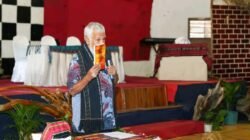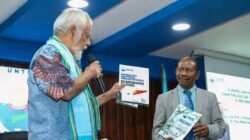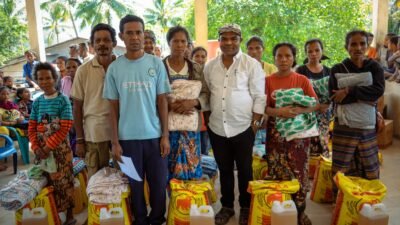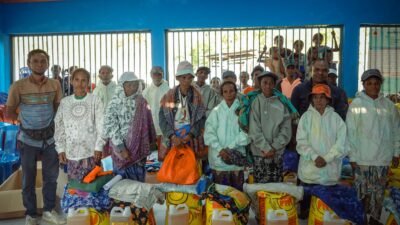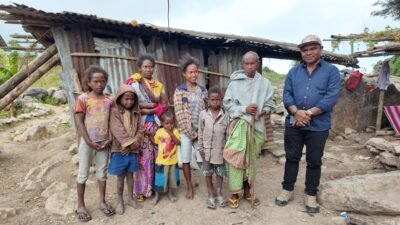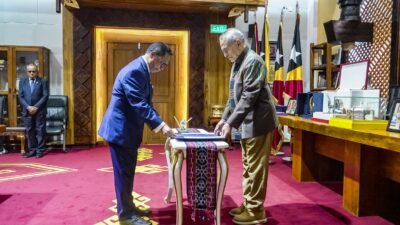



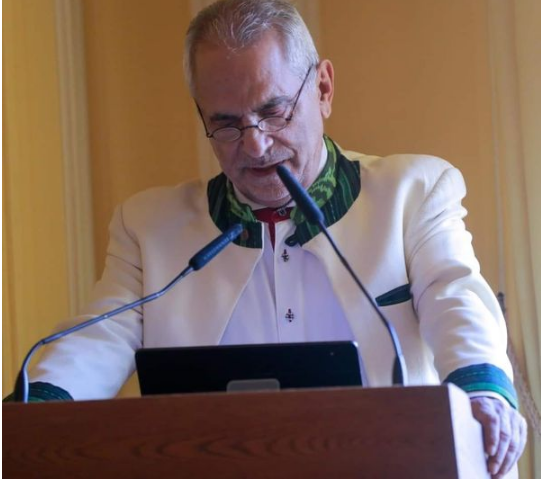
ACTIVIDADES INTENSAS EM GENEBRA, 2 – 4 Outubro 2023
Reuniões produtivas na Organização Mundial do Comércio,
Organização Mundial de Saúde, Forum Económico Mundial,
e varias intervenções públicas, encontro-jantar oferecido pelo Embaixador Rui Macieira de Portugal com membros do Corpo Diplomático de Genebra.
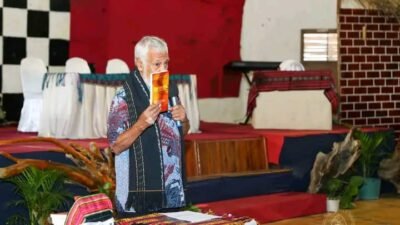
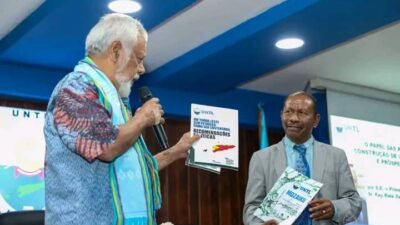
Discurso breve por ocasião de outorga do “Prémio Maria Teresa di Borbone Di Parma International Prize for Hope in Humanity”
“The UNSC, comprising the five nuclear powers, China, France, Russia, United Kingdom and UnitedStates, utterly failed in its mandate to prevent conflicts, promote peace through dialogue.”
“When one permanent member of the world’s security body commits an act of armed aggression in violation of the UN Charter and International Law…no one should expect that in the face of such blatant aggression against a sovereign country, the US, European countries and others across the world to be indifferent and simply look the other way”.
“Ukraine was and is in its sovereign rights to expect International action in words and deeds to counter Russia’s aggression”. J. Ramos-Horta
(Excerpts only)
Speech by J. RAMOS-HORTA
Presidentof the Democratic Republic of Timor-Leste
Upon receiving the “Maria Teresa di Borbone Di Parma International Prize for Hope in Humanity”
Geneva, 4th October 2023
Global crises such as pandemic, climate change and the war on Ukraine, the resulting geopolitical fragmentation, have gravely impacted the fragile countries. The forgotten peoples living in the periphery of the afluent world are the ones who suffer the brunt of global crisis over which these countries are the least responsible.
It has become almost an academic cliché to say we are living in dangerous times, in a fragmented, leaderless world, it feels like we are passengers in a ship adrift in stormy seas. The multilateral security architecture painstakingly built over many decades and which did contribute to prevent conflicts and at times enforced peace seems to be unraveling into irrelevance.
Wars and destruction, extreme suffering go on but the mainstream media has “moved on” and we have forgotten the children of the tragedies of Myanmar, Afghanistan, Yemen, Syria, Palestine, DRC,
In Myanmar the military pursue a scorched earth strategy with widespread use of aircraft and helicopters targeting civilians across the country. At least 3,000 civilians have been killed and 17,000 people arbitrarily imprisoned, including legitimately elected leaders including Nobel Peace Laureate Aung Suu Kyi.
Extreme poverty, unemployment, malnutrition, humanitarian crises caused by wars, climate change and geo-economic fragmentation are daily occurrence, in rich and poor countries and regions. But the impact on fragile countries and countries in conflict is many times greater, more profound and without prospects of recovery in short and medium term. Humanitarian agencies are stretched to the limits, unable to mobilize resources needed to respond to these man-made crisis.
Our Common Home, Planet Earth, has been wrecked over centuries by us, its human predators. And it is in such existential challenging times that we realize how we are lacking visionary, inspiring global leaders capable of summoning leaders and people to take action and rescue the planet, free hundreds of millions of our fellow human beings from pervasive extreme poverty.
The growing tensions and confrontation among regional and global powers are eroding the potential of our collective security institutions, weakening us further at a time when we face serious existential challenges. We are seeing the risks of rival powers inching closer to armageddon.
Timor-Leste condemns the invasion, violation of sovereignty and territorial integrity of Ukraine, and the ongoing war with its catastrophic consequences for the Ukrainian people and for the rest of the world with the disruption of global trade in grain and energy.
The UNSC, comprising the five nuclear powers, China, France, Russia, United Kingdom and UnitedStates, utterly failed in its mandate to prevent conflicts, promote peace through dialogue. Obviously when one permanent member of the world’s security body commits an act of armed aggression in violation of the UN Charter and International Law on the prohibition of the use of force, no one should expect that in the face of such blatant aggression against a sovereign country, the US, European countries and others across the world to be indifferent and simply look the other way. Ukraine was and is in its sovereign rights to expect International action in words and deeds to counter Russia’s aggression.
But we also know from experience and history that very seldom wars are won on the battlefield, miscalculations and false pride prevail, wars may go on for years, killings and utter destruction will continue until exhaustion…only then the sides involved decide to begin negotiations on a peace settlement. It is time for Russia to withdraw from Ukrainian internationally recognised sovereign territory; it is also time for all to understand that with a military alliance at its gates, Russia requires unambiguous guarantees for its own security from Ukraine’s, friends and allies. Both Russia and Ukraine have equal rights to expect full respect and iron clad guarantees for the independence and integrity of their respective territories.
Let me turn to positive stories, it is not all gloom. Timor-Leste is a young, vibrant democracy, an Oasis of peace, tolerance and freedom. The Economist magazine’s “Democracy Index” ranks Timor-Leste the most democratic country in Southeast Asia; Reporters Without Borders in its latest “World Press Freedom Index” ranks Timor-Leste’s number 10 globally in media freedom.
We are a multicultural, multi-religious, multilingual and multi-ethnic society. With humility we continue to build a country that is open to the world, tolerant, free of hatred and violence.
Our 98% practicing Catholics live in harmony with our Protestant and Muslim brothers and sisters. Timor-Leste has zero political violence, zero ethnic based or religious based tensions or crime. We do not have domestic organized crime or armed robbery.
In the 20 years since independence and 10 years since we formally applied to join ASEAN, most economic and social indicators show significant progress, namely, life expectancy, less than 60 years in 2002, 70 now), reduction in poverty and infant mortality, 21 doctors in 2002, now more than 1,200. In 2002 electricity partially covered the capital while the rest of the country did not have this privilege. Now it covers 96,1 % of the territory.
We are not an aid dependent country and we are forever grateful to those who have come to our aid in times of great need. We finance our own National Budget from the returns of a Sovereign Fund invested in US Treasury Bonds, in other developed markets bonds, and in global financial markets, with an annual return of over 9%. (Source: Gabinete de Política e Gestão do Fundo Petrolífero de Timor-Leste, Relatório Anual 2022, Ministério de Finanças)
Extreme hunger, poverty and humanitarian crises caused by wars, climate change and geo-economic fragmentation are increasingly concentrated in fragile and conflict affected countries. The slow or zero achievement (on part of some Goals) of the targets of Agenda 20230 and its Sustainable Development Goals owes to a great extent to the current global crises such as the pandemic, war on Ukraine, incidents of natural disasters due to climate change and conflicts.
Armed conflicts proliferate, social conditions are worsening in countries around the world but as the mainstream media has “moved on” we too have forgotten the children living in conflict zones who continue to come under attack on an alarming scale.
In Myanmar the military pursue a scorched earth strategy with widespread use of aircraft and helicopters targeting civilians across the country. At least 3,000 civilians have been killed and 17,000 people arbitrarily imprisoned, including legitimately elected leaders such as Nobel Peace Laureate Aung Suu Kyi.
Our Common Planet Earth has been wrecked over centuries by us, the inhabitants of this Common Home of ours. We are Earth’s worst predators. And it is in such existential challenging times that we realize how we are lacking visionary leaders capable of summoning all to rescue the planet, free hundreds of millions of our fellow human beings from pervasive extreme poverty.
We must seriously reflect on the inevitable reality that in this increasingly interconnected Global Village, a problem in a neighboring or distant country is ours too, as it can cross borders, morphed into global pandemics, natural disasters, social, humanitarian and migratory crises, food insecurity and volatile commodity prices.
We need a new outlook on the climate and security nexus, which will address the impacts of climate change and environmental degradation on peace, security and ensure that the quest for energy transition does not worsen the security situation in vulnerable and fragile countries.
We have differentiated responsibility in regards our common Planet. We Timor-Leste have ZERO responsibility in the degradation of this Planet, our CO2 emmision is estimated at 0,003 % of global emissions.
But we are willing to contribute to the global debate on credible and fair alternatives to non renewable energies and sustainable development, with a bold initiative that would accelerate a just energy transition in fragile developing states that heavily rely on oil and gas production to prevent turmoil and unrest.
The combined efforts of unlocking finance through debt alleviation, streamlining international finance at lowest interest rates, and significantly increasing official development assistance will empower these nations to embark on projects that foster the development of clean industries, address the ongoing loss and damage related to climate change, and facilitating their efforts in greenhouse gas mitigation and adaptation to climate change.
As a second priority, this initiative pay urgent attention to the particular challenges faced by fragile states that are not only susceptible to fragility and vulnerability on their own but where there is heightened risk when faced with any massive economic turmoil, which the green transition – if not handled carefully – could increase.
Thirdly, as the urgency to transition to a low-carbon economy and clean energy accelerate, this initiative will seek to ensure that the quest for rare earth elements and critical minerals does not lead to further instability nor promote weak governance or exacerbate local tensions nor grievances in the countries where strategic reserves of such elements and minerals are found.
This initiative seeks to create a brighter and more sustainable future for our planet and all its inhabitants. By facilitating the energy transition in small island development states, LDCs and climate vulnerable nations, we aim to mitigate climate change impacts and preserve our shared global environment for generations to come.
But the super-rich CEOs of banks and creditor countries, facing the agony of poverty, rising cost of living in the most impoverished countries, remain defiant of the international calls for debt cancellation. Banks must do their share and a fair share of the burden would require a visionary, bold leadership in writing off the debt of all Third World countries so we all have a second chance, a chance unburdened by the debt trap, a chance to embark on new development strategies, peoples centered, to free peoples from extreme poverty.
Overseas Development Assistance (ODA) has been in decline since the 2007 subprime crisis, exacerbated by the COVID-19 pandemic and the war against Ukraine. Some official OECD data show a significant increase in ODA but this is due to the dramatic surge in humanitarian and other support packages for Ukrainian refugees.
It would be a leap forward in international solidarity if each OECD country were to allocate 1% of its national GDP to ODA. We would see positive effects on poverty rates, food security, access to basic health services, education, electricity, drinking water, sanitation, housing or social security, with multiplier effects on the diversification of economies, especially in agriculture.
The billionaires of the affluent North and the billionaires of the affluent South should come together around the creation of a Global Fund for Education and Health, and an Energy Transition Regime, sharing of innovations, taking advantage of the new global communication networks and spaces.
We live in a Universe full of Dualities: an increasingly prosperous World, whose wealth has increased by 30 trillion a year, according to Nobel Prize winner Kailash SATYARTHI, but the leaderships of the G7 or G20 fail to reflect this in the fight against hunger, stunting and other forms of multidimensional poverty.
BELE HARE MOS REPORTAJEN TOPIKU ATUAL IHA KANAL TVET ( HUSI JENEBRA)
Semua tanggapan:
52